
 Facebook
 X
X
 Pinterest
 Copy Link
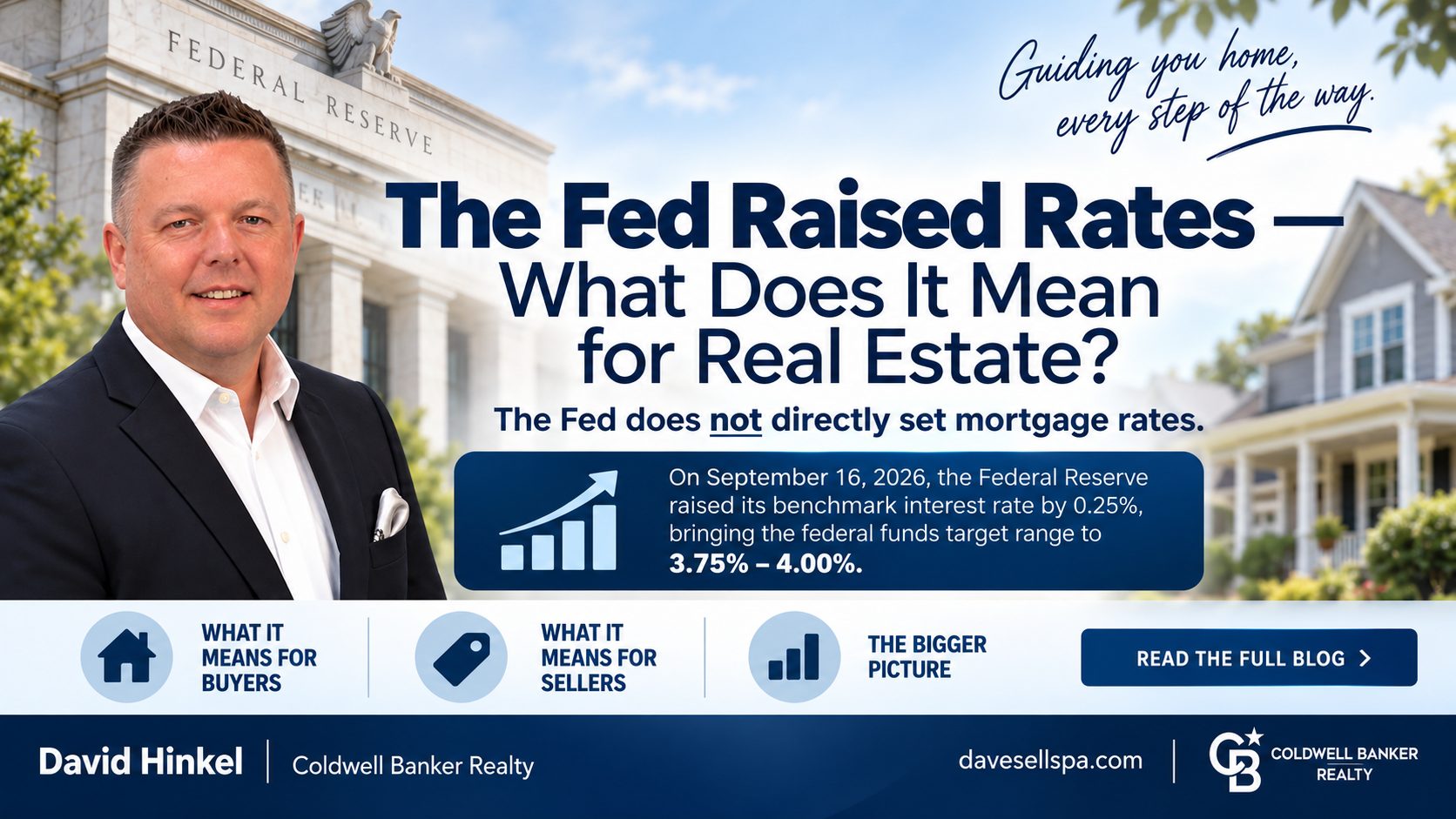
The Fed Raised Rates: What Does It Mean for Home Buyers and Sellers?
September 16, 2026 | By David Hinkel, Coldwell Banker Realty
When you hear that the Federal Reserve raised interest rates, it is easy to assume that mortgage rates immediately went up by the same amount.
That is not exactly how it works.
On September 16, 2026, the Federal Reserve raised the target range for the federal funds rate by 0.25 percentage point, bringing it to 3.75%–4.00%. The Fed cited elevated inflation and its goal of returning inflation to 2%.
So, what does this actually mean if you are considering buying or selling a home in Pennsylvania?
First: The Fed Does Not Directly Set Mortgage Rates
This is probably the most important point for consumers to understand.
The Federal Reserve controls the federal funds rate, which is a short-term interest rate used in the banking system. It does not announce or establish the rate you will receive on a 30-year mortgage.
Mortgage rates are influenced by a combination of factors, including Treasury yields, inflation expectations, economic conditions and financial-market expectations about where monetary policy is headed.
That means a 0.25% Fed increase does not automatically equal a 0.25% increase in your mortgage rate.
In fact, financial markets often begin reacting to an anticipated Fed decision before the Fed actually makes its announcement.
What Does the Rate Increase Mean for Home Buyers?
For buyers, the number to pay attention to is not simply the Fed’s rate. It is your actual mortgage rate, monthly payment and purchasing power.
When mortgage rates rise, the monthly payment on the same loan amount increases. Depending on your budget, that can affect how much home you are comfortable purchasing.
But that doesn’t automatically mean you should stop looking for a home.
Instead, this is a good time to have a detailed conversation with your mortgage lender about:
- Your comfortable monthly payment
- Your current purchasing power
- Different loan programs that may be available
- Down payment options
- Whether seller concessions or a rate buydown could make sense
- How a change in mortgage rates would affect your particular price range
Trying to perfectly time mortgage rates can be extremely difficult. Knowing your numbers allows you to make a decision based on your financial situation rather than a headline.
What Does This Mean for Home Sellers?
Interest rates matter to sellers because they affect buyer affordability.
When borrowing becomes more expensive, some buyers may adjust their price range, take longer to make a decision or temporarily step out of the market.
That doesn’t mean homes stop selling.
It means pricing, presentation and marketing become even more important.
Today’s seller needs a strategy that considers the competition, current inventory, recent comparable sales, buyer activity and how the property will be positioned when it hits the market.
Simply putting a home in the MLS and waiting is not a marketing strategy.
Could Mortgage Rates Go Higher?
They could. They could also move lower.
The Federal Reserve’s September economic projections show that policymakers have different views about the appropriate path for interest rates going forward. Those projections are not guarantees or promises about future Fed decisions.
That is another reason I encourage buyers and sellers not to make a major real estate decision based entirely on predictions about where rates might be six months from now.
Real Estate Is Local
National headlines are important, but they don’t tell you everything about what is happening in your local housing market.
Inventory, days on market, buyer demand, property condition, school district, neighborhood and price range can create very different market conditions even between nearby communities.
A $400,000 home may experience completely different buyer activity than a $900,000 home in the same county.
That is why I believe good real estate advice should combine the larger economic picture with actual local market data.
Should You Buy or Sell After the Fed’s Rate Increase?
There isn’t one answer that applies to everyone.
If you’re buying, the important questions are whether you can comfortably afford the payment, whether the right property is available and whether purchasing fits your longer-term goals.
If you’re selling, the questions are what your home is worth in the current market, what competition you will face and what marketing and pricing strategy will put you in the strongest position.
Don’t let one Fed headline make the decision for you. Understand the numbers first.
Have Questions About What This Means for You?
If you’re considering buying or selling a home in Berks County, Chester County, Lancaster County or surrounding Pennsylvania communities, I’m happy to help you understand what is happening in the market and how it could affect your plans.
No pressure. Just questions, answers and a clear strategy.
David Hinkel | REALTOR®
Coldwell Banker Realty
📱 610.909.5431
📧 david.hinkel@cbhomes.com
🌐 davesellspa.com
Guiding you home, every step of the way.
For the source links, Federal Reserve’s September 16 FOMC statement and its September 2026 economic projections
Podcast: Play in new window | Download
